Faucet & Sink
Is Hot Water Always on the Left? Fixture Orientation Basics
Handle position alone does not prove how a fixture is connected. Identify the exact product, document only visible lines and markings, and use its instructions before deciding what is wrong.
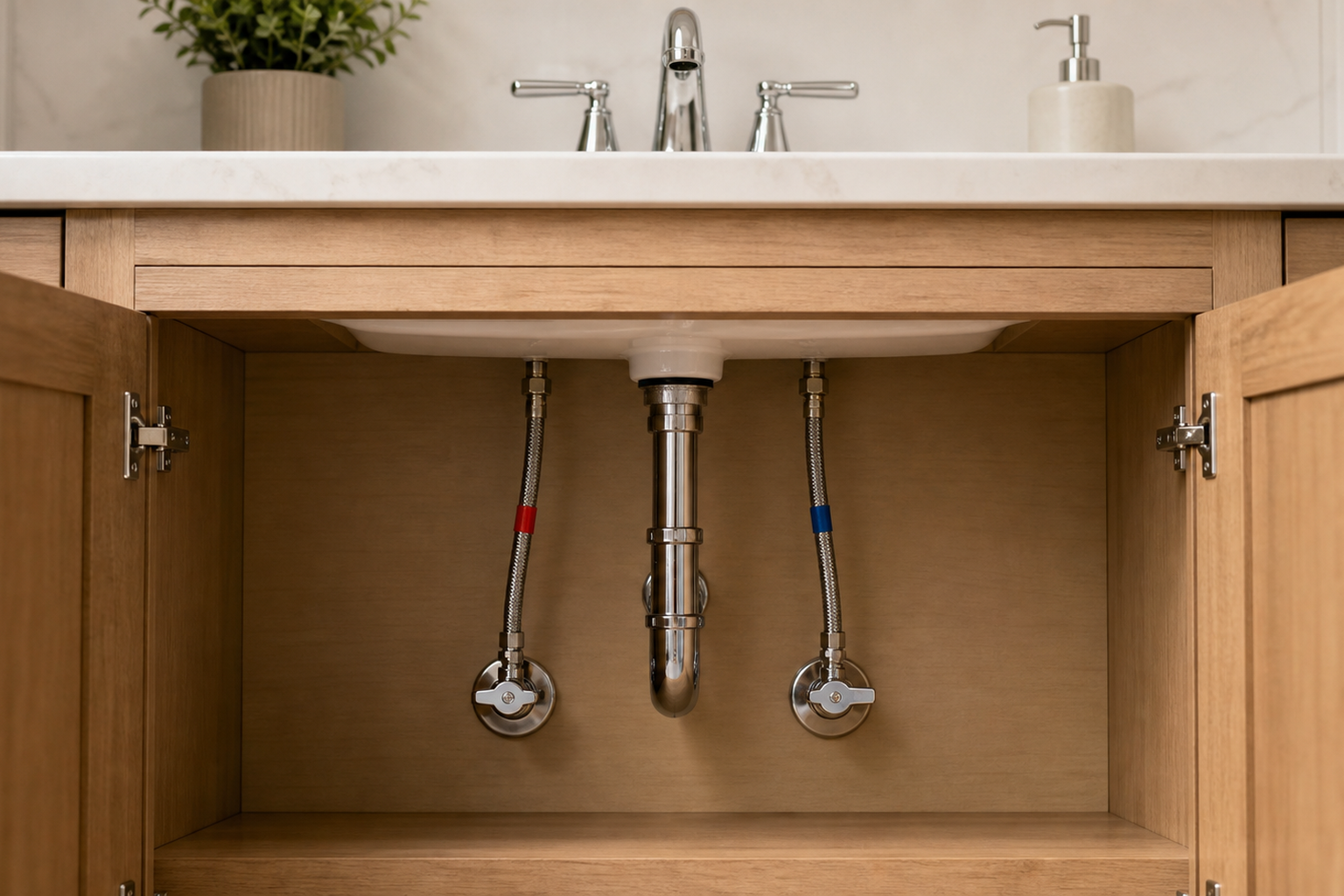
What to know about hot-water orientation
No. A control or visible supply line on the left does not prove how an unidentified fixture is connected. In one specific example, Moen’s 1220/1225 cartridge guidance calls hot-left and cold-right the standard arrangement, but that product-specific statement is not a rule for every faucet, shower valve, or installation.
Use the exact product number, visible markings, actual temperature, accessible supply-line positions, and the matching product documentation together. Do not diagnose a hidden connection or select a replacement cartridge from handle position alone.
Safe identification table
| Cited product context | What the cited examples establish | What to verify |
|---|---|---|
| Moen faucet using a 1220 or 1225 cartridge | Moen’s 1220/1225 page describes hot-left and cold-right for that cartridge context. | Exact faucet and cartridge numbers, markings, actual temperature, and visible line positions. |
| Single-handle faucet | Moen lists different instructions for the specific 1225, 1255, and 4000 cartridges. | The exact cartridge number and its matching manufacturer support document. |
| Moentrol shower valve | Moen’s temperature-limit guidance is specific to the Moentrol system. | The exact valve identity and measured temperature; do not transfer its setting instructions to another valve. |
What to check before assuming
- Identify the fixture type and record the manufacturer and exact model number.
- Record the exact cartridge or valve part number and every visible hot/cold marking.
- For an accessible sink faucet, document the visible supply-line positions without disconnecting anything.
- Run the fixture briefly and note which control position produces hot water; do not treat that observation as proof of hidden pipe routing.
- Use the matching manual or manufacturer support page before buying a cartridge or changing a valve setting.
Why position alone is not proof
A handle marking shows the intended control, a visible supply line shows only the accessible part of its route, and a temperature check shows the result at that moment. None of those observations alone identifies concealed piping or an internal part.
Moen’s cited FAQ gives one instruction for a listed 1225 cartridge and a different instruction for the listed 1255 and 4000 cartridges. That difference is why an instruction for one identified cartridge should not be applied to an unidentified faucet.
Document the exact product number, accessible connections, affected fixtures, and observed temperature behavior. If those facts conflict, stop at documentation and give them to the manufacturer or a qualified plumber rather than guessing at a repair.
When to stop and call for help
Observation is appropriate when you can read the markings, identify the model, and check the temperature without opening or disconnecting the fixture. Stop before removing a concealed trim plate, loosening a stuck valve, disconnecting a pressurized line, or changing a shower limit stop from a generic diagram.
- Stop if the shower or tub is unexpectedly hot, the temperature changes sharply, or someone could be scalded.
- Stop if hot and cold are reversed at more than one fixture or visible supply lines conflict with the fixture markings or its exact product documentation.
- Stop if a connection leaks, a valve is seized, a wall or ceiling is involved, or the fixture model cannot be identified.
- Give the plumber the model number, photos of accessible connections, the affected fixtures, and the observed temperature behavior.
Shower and tub safety boundary
A reversed shower temperature response or unexpectedly hot water is a safety issue, not just a labeling issue. Moen’s support guidance treats temperature-limit settings as product-specific and says its plumbing guidance recommends that shower water not exceed 120°F. Do not transfer that number or a cartridge procedure to another valve as universal code. If the shower or tub is too hot, the handle does not behave as expected, or the valve is concealed, stop and use the exact manufacturer instructions or a qualified plumber.
Make the service handoff more useful
Before contacting the manufacturer or a plumber, make one short record for each affected fixture: the room, fixture type, model or cartridge number if visible, which control position produced hot water, and whether the same reversal appears elsewhere in the home. Add clear photos of the trim, markings, and any accessible supply lines without opening the wall or disconnecting anything.
This separates a single-fixture control or cartridge question from a house-wide orientation problem and gives the professional enough context to bring the right documentation or parts. It also avoids repeating temperature checks when unexpectedly hot water has already made further testing inappropriate.
Sources used
These manufacturer pages document the limited product examples described above. For any other fixture, use the instructions for its exact model and part number.
- Moen: How to Reverse Hot and Cold for a 1225 Cartridge in a Kitchen Faucet — describes hot-left/cold-right as standard in its 1220/1225 cartridge context and documents notch positions for two visible supply-line layouts.
- Moen: Reversed hot and cold on a one-handle kitchen or bathroom sink faucet — lists different instructions for the specific 1225, 1255, and 4000 cartridges; an instruction for one listed cartridge does not establish the instruction for another.
- Moen: How to Adjust the Moentrol Temperature Limit Stop — supports the Moentrol-specific shower-temperature and scald-safety boundary.
- Moen: Sink Faucets — describes red/blue markings as a general hot/cold symbol and explains how to identify an exact Moen faucet before selecting parts.