Dishwasher
Dishwasher Leaking Under the Sink: What to Document First
Separate dishwasher hose, air gap, disposer inlet, sink drain, supply valve, and condensation clues before touching under-sink connections.
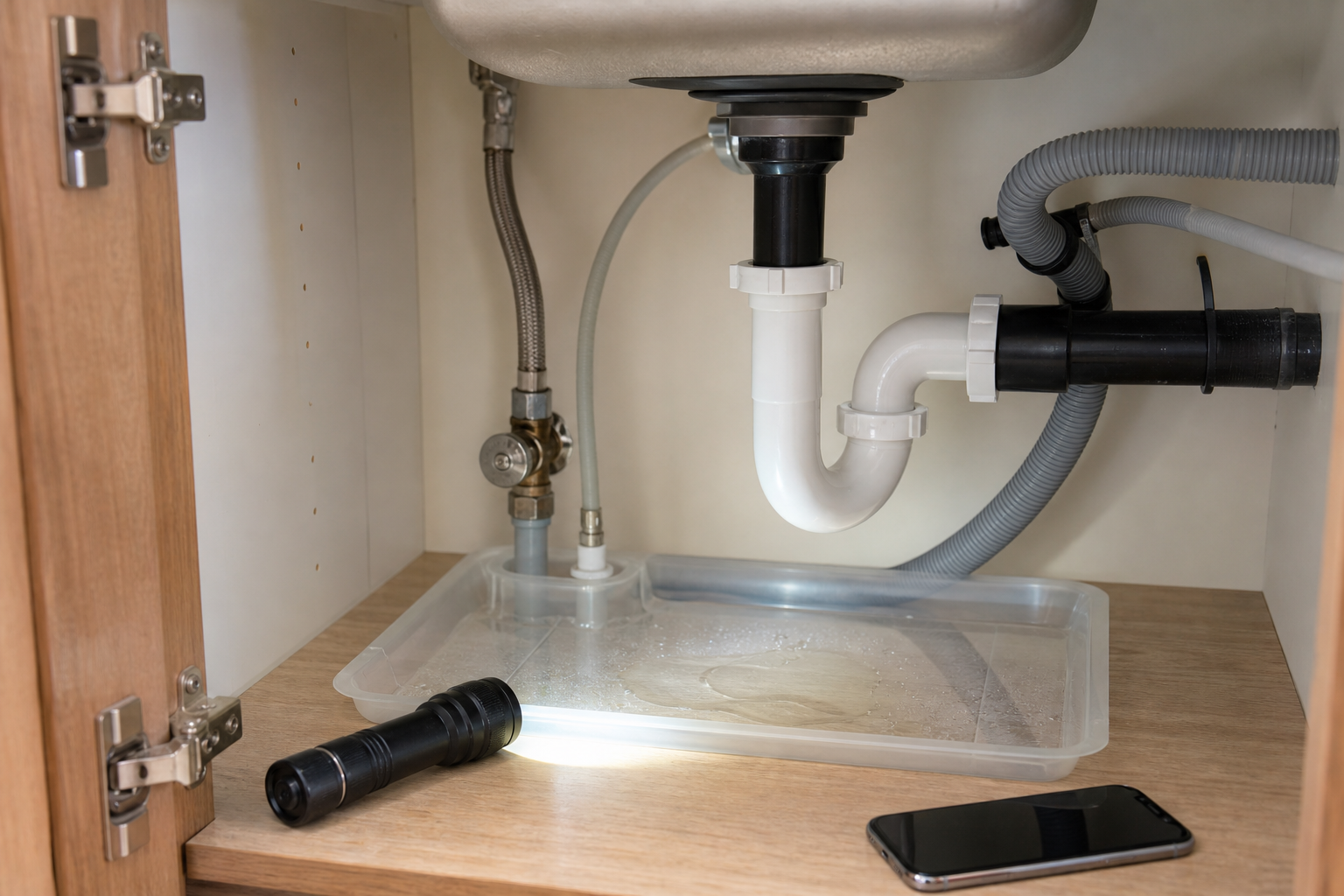
What to know about Dishwasher Leaking Under the Sink: What to Document First
A dishwasher leak under the sink can come from the dishwasher drain hose, air gap, disposer inlet, sink drain, supply valve, cabinet condensation, or the garbage disposal itself. The safest first step is to stop the cycle if water is active, protect the cabinet floor, photograph the exact wet area, and separate appliance symptoms from plumbing-connection symptoms before touching hoses.
Leak-source decision tree
- Is water actively spreading? Stop the dishwasher, avoid electrical parts, and dry only what you can reach safely.
- Does water appear from the air gap on the counter? Check the air-gap cap and hose path; recent disposer replacement raises knockout-plug suspicion.
- Is the disposer inlet or hose clamp wet? Photograph the connection and note whether the disposer was recently installed.
- Is the sink drain or trap wet even when the dishwasher is off? Treat it as a sink-drain leak, not primarily an appliance leak.
- Is the supply valve or braided line wet? Stop; do not force old shutoff valves or loosen supply connections.
- Is the cabinet damp but no fitting is dripping? Consider condensation, past spill, or intermittent leak; document timing.
Leak-location table
| Wet area | Likely system | Who usually helps |
|---|---|---|
| Corrugated or rubber dishwasher drain hose | Dishwasher drain connection | Appliance tech or plumber depending on connection access. |
| Air gap body or counter opening | Air gap / drain route | Plumber if hose routing or disposer inlet is involved. |
| Disposer dishwasher inlet | Disposal connection / knockout plug | Plumber or disposer installer; use manual-first checks. |
| P-trap, tailpiece, basket strainer | Sink drain assembly | Plumber. |
| Supply stop or braided supply line | Pressurized water supply | Plumber; do not force or loosen a leaking valve. |
| Cabinet walls/floor with no active drip | Condensation, old spill, intermittent leak | Document timing and recheck during fill/drain cycle. |
What to photograph before service
- Dishwasher model number and any error code.
- Full under-sink layout showing air gap, high loop, disposer, trap, supply valve, and drain hose.
- Close-up of the wet fitting with a dry paper towel or tape marker showing the drip point.
- Whether the leak occurs during fill, wash, drain, or after the cycle.
- Recent changes: new disposer, new faucet, drain cleaning, cabinet work, or dishwasher movement.
Manual-first checks
Use the dishwasher installation manual to identify the drain hose routing, required high loop or air gap, and approved connection method. Use the disposer manual to confirm whether a dishwasher inlet knockout plug applies to your model. Do not remove hoses, clamps, or electrical covers from a generic article.
Cleanup and moisture warning
Remove stored items, dry the cabinet, and keep photos of swelling, stains, odor, or recurring dampness. If water touched electrical outlets, the dishwasher junction area, flooring, drywall, or mold-like growth, stop and call the appropriate professional.
Plumber vs appliance technician thresholds
| Call | When |
|---|---|
| Plumber | Sink drain, trap, air gap, disposer inlet, supply valve, shutoff, cabinet/floor leak, or water in walls/floors. |
| Appliance technician | Door seal, pump, internal dishwasher leak, model error code, tub leak, or dishwasher not completing drain cycle. |
| Electrician / emergency help | Water near outlets, wiring, burning smell, shock risk, or unsafe breaker/GFCI behavior. |
What to document before service
- Brand, model number, serial tag location, and any blinking lights or error code.
- When the issue happens: startup, fill, wash, drain, dry cycle, or after sitting unused.
- Photos of the filter area, spray arms, detergent cup, air gap/high loop, under-sink drain connection, and any floor or cabinet water.
- Recent changes: new detergent, rinse aid, disposer installation, plumbing work, power outage, or water-quality changes.
Decision aid: Dishwasher Leaking Under the Sink: What to Document First
Start by identifying the relevant symptom, fixture, or planning question before choosing parts or arranging work.
Write down when the issue began, what changed, which fixtures are affected, and any model or service-history details. That record makes it easier to compare the article with the exact product documentation and to explain the problem if qualified help is needed.
- Find the exact model manual and separate appliance behavior from the drain hose, air gap, disposer, or sink connection.
- Match product-specific directions to the exact model manual and confirm local requirements where installation, gas, electricity, water quality, or structural work is involved.
- Stop for leaking near electrical parts, repeated error codes, a recently disturbed hose, or water that returns after visible cleaning.
Authoritative references for this topic
Use the current version of these sources to verify safety, efficiency, health, or product-specific details that apply to your situation.