Dishwasher
How to Choose Dishwasher Detergent for Your Water and Machine
Choose dishwasher detergent by water hardness, cycle type, machine manual, rinse-aid guidance, and label compatibility.
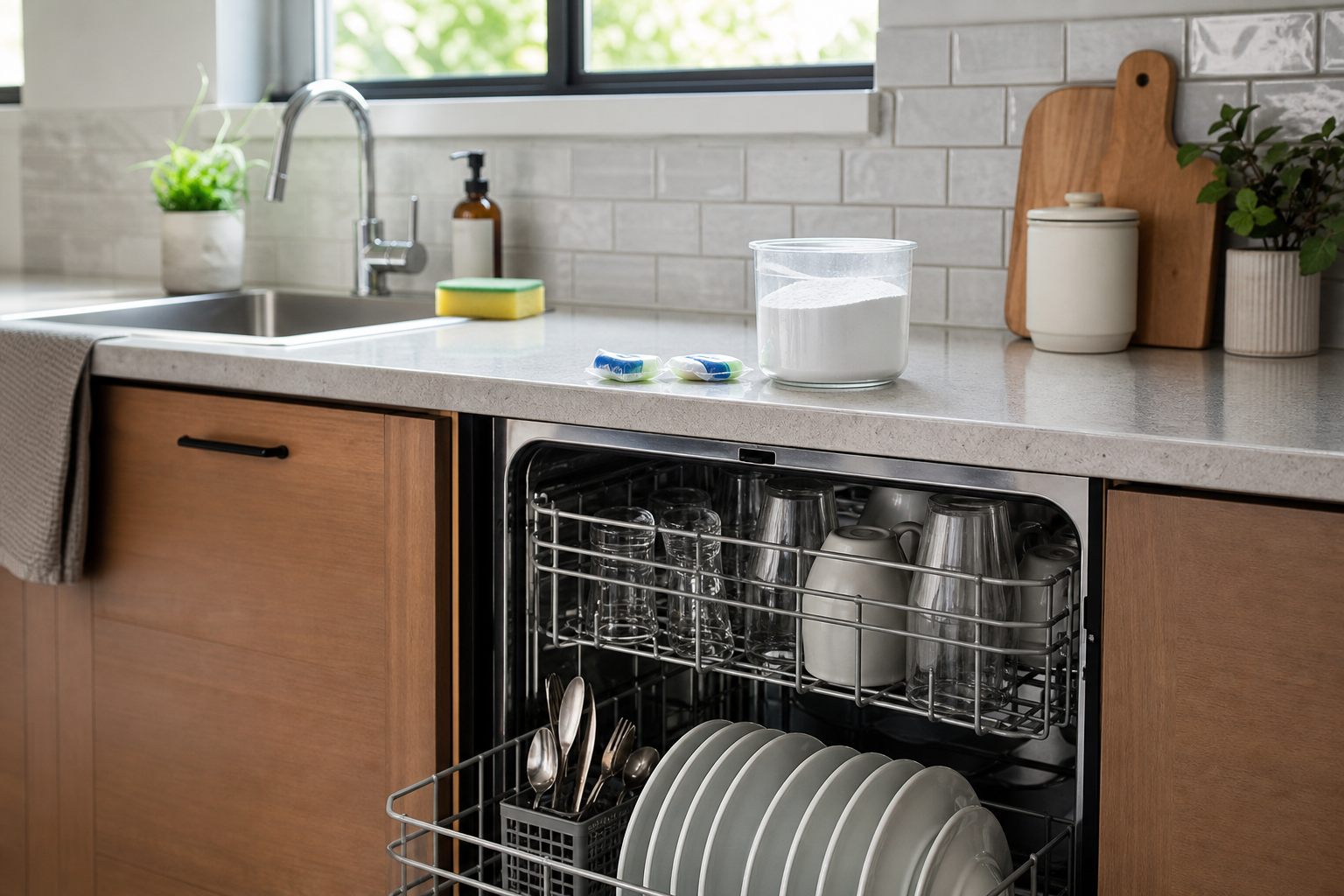
What to know about How to Choose Dishwasher Detergent for Your Water and Machine
Choose dishwasher detergent by matching the machine manual, water hardness, cycle type, rinse-aid guidance, and current product label. There is no universal “best” detergent for every dishwasher and water supply.
Detergent fit table
| Household clue | Often worth checking | Common mistake |
|---|---|---|
| White film or spots | Water hardness, rinse aid, dose. | Adding more detergent without cleaning filter. |
| Pod does not dissolve | Cycle temperature, dispenser dryness, spray path. | Using quick/cool cycles for every load. |
| Etching on glass | Detergent dose, soft water, cycle heat. | Assuming all cloudiness is removable film. |
| Odor | Filter/gasket/tub cleaning first. | Blaming detergent while food debris remains. |
Manual-first checklist
- Read the detergent and rinse-aid section in the exact dishwasher manual.
- Check local water hardness or utility report if available.
- Verify current label directions and storage requirements.
- Do not use hand dish soap in a dishwasher.
Decision aid: How to Choose Dishwasher Detergent for Your Water and Machine
Start by identifying the relevant symptom, fixture, or planning question before choosing parts or arranging work.
Write down when the issue began, what changed, which fixtures are affected, and any model or service-history details. That record makes it easier to compare the article with the exact product documentation and to explain the problem if qualified help is needed.
- Find the exact model manual and separate appliance behavior from the drain hose, air gap, disposer, or sink connection.
- Match product-specific directions to the exact model manual and confirm local requirements where installation, gas, electricity, water quality, or structural work is involved.
- Stop for leaking near electrical parts, repeated error codes, a recently disturbed hose, or water that returns after visible cleaning.
Authoritative references for this topic
Use the current version of these sources to verify safety, efficiency, health, or product-specific details that apply to your situation.