Faucet & Sink
Cleaning and Maintaining a Copper Sink: Finish-Safe Care Checks
Copper sink care depends on finish type, patina goals, cleaner compatibility, drying habits, and when to call the maker or plumber.
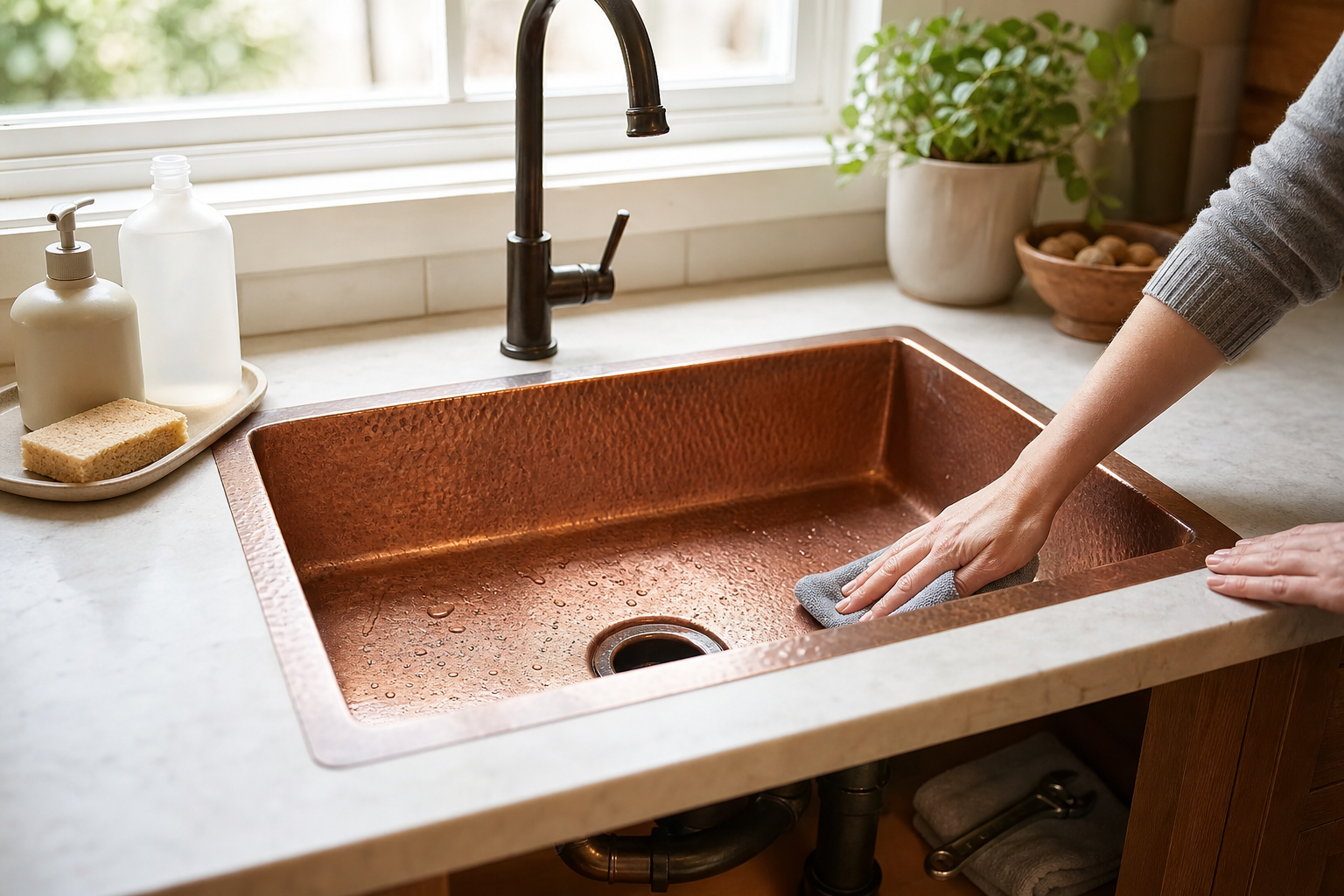
What to know about Cleaning and Maintaining a Copper Sink: Finish-Safe Care Checks
Clean and maintain a copper sink by protecting the finish first: identify whether it is raw, hammered, lacquered, waxed, or intentionally patinated, then use mild cleaners, soft cloths, prompt drying, and manufacturer-approved products. Do not treat a copper sink like stainless steel; acids, abrasives, bleach, ammonia, and aggressive polish can permanently change the color or remove the intended patina.
Copper finish decision table
| Copper sink condition | What it usually means | Safer care approach |
|---|---|---|
| Living/raw copper patina | Color will naturally darken and vary | Mild soap, water, soft cloth, dry after use. |
| Lacquered/sealed copper | Clear coating protects a more stable look | Avoid polish/abrasives; follow manufacturer cleaner list. |
| Hammered/textured copper | Texture can trap residue in low spots | Soft brush only if maker allows; rinse well. |
| Bright polished copper | Requires repeated gentle polishing to stay bright | Use copper-safe product only; test hidden area. |
| Green/blue deposits or pitting | Chemical exposure, standing water, or corrosion concern | Stop harsh cleaners; contact manufacturer/installer. |
Routine care checklist
- Rinse food residue, toothpaste, soaps, and acidic liquids promptly.
- Wash with mild dish soap and a soft cloth or non-scratch sponge.
- Dry around the drain, rim, faucet base, and backsplash after heavy use.
- Use a sink grid or mat only if it does not trap moisture against the copper.
- Keep bleach, drain cleaner, oven cleaner, toilet cleaner, and abrasive powders away from the basin.
- Save the brand/model care sheet because copper finishes vary widely by maker.
Stain or color-change table
| Symptom | Possible cause | Next step |
|---|---|---|
| Uneven darkening | Normal patina from use | Leave it, or ask maker about approved brightening. |
| Light rings or spots | Acidic foods, hard water, soap residue | Clean gently; avoid repeated acid soaking. |
| Scratches | Abrasive pad, grit, cookware, or dropped object | Do not sand aggressively; ask manufacturer/refinisher. |
| Green/blue crust | Chemical residue or prolonged moisture | Clean gently and check for ongoing leaks/standing water. |
| Peeling clear coat | Damaged lacquer/sealant | Stop polishing; contact maker/installer. |
What not to do
- Do not use bleach, ammonia, drain cleaner, toilet cleaner, steel wool, or abrasive powders.
- Do not soak vinegar/lemon juice/salt mixes on copper unless the manufacturer specifically permits it.
- Do not polish a lacquered copper sink unless the care sheet says the coating is meant to be polished.
- Do not ignore leaks or standing water around the drain flange; moisture can damage surrounding cabinetry and finishes.
When to call a pro
Call the sink manufacturer, installer, or a metal refinisher if the finish is peeling, pitted, deeply scratched, uneven in a way you do not want, or chemically damaged. Call a plumber if staining is tied to a leaking faucet, drain flange, disposal connection, or supply line, or if water is reaching the cabinet below.
Fixture, drain, and finish boundary
Decision aid: Cleaning and Maintaining a Copper Sink: Finish-Safe Care Checks
Start by identifying the relevant symptom, fixture, or planning question before choosing parts or arranging work.
Write down when the issue began, what changed, which fixtures are affected, and any model or service-history details. That record makes it easier to compare the article with the exact product documentation and to explain the problem if qualified help is needed.
- Separate a faucet or supply symptom from a drain symptom, and note whether it affects hot water, cold water, or both.
- Match product-specific directions to the exact model manual and confirm local requirements where installation, gas, electricity, water quality, or structural work is involved.
- Stop if water reaches a cabinet, wall, floor, or electrical part, or if a shutoff or fixture starts to move when it should not.
Authoritative references for this topic
Use the current version of these sources to verify safety, efficiency, health, or product-specific details that apply to your situation.