Toilet
Standard Toilet Height: What to Check Before Buying
There is no universal standard toilet height; compare exact floor-to-rim, floor-to-seat, rough-in, projection, and overall dimensions before buying.
Quick answer
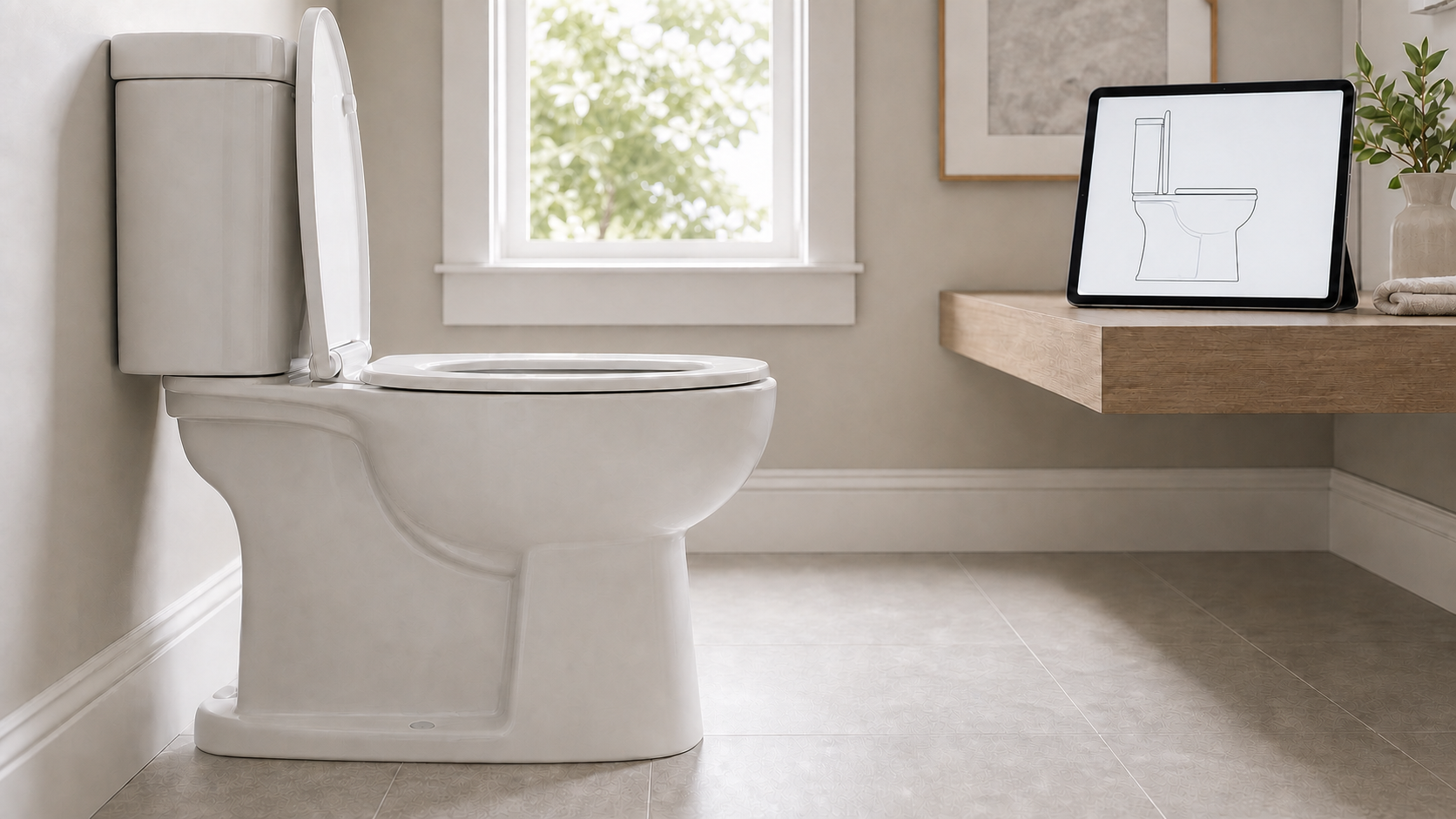
There is no single universal “standard toilet height.” Product documents may show a porcelain bowl height, a finished height to the top of an installed seat, or an overall tank height. Those are different dimensions. Compare the exact model drawing and measure from the finished floor to the same endpoint.
Two exact products sold as “Standard Height” illustrate why the label is not one number. American Standard’s Reliant 3332DB101CR.020 drawing shows 15 inches from finished floor to the bowl rim. KOHLER’s Reach Curv K-23188 drawing shows 15-9/16 inches to its ceramic-rim datum and a separate 1-1/8-inch rise to the top of the depicted included seat. These are model-specific nominal dimensions, not an industry-wide range.
First ask: which toilet height?
| Dimension | Measurement endpoints | Why it matters |
|---|---|---|
| Bowl or rim height | Finished floor to top of the porcelain rim, without adding seat thickness | Many manufacturer drawings dimension the bowl at this point |
| Finished seat height | Finished floor to top of the installed seat | This is the surface the user sits on and the endpoint named in ADA §604.4 |
| Overall height | Finished floor to highest point of the assembled toilet, usually the tank lid | This affects shelves, windows, counters, and visual fit but not sitting height |
| Rough-in | Finished wall to the centerline of the waste outlet or installed closet bolts | This is a floor-layout dimension, not a height |
| Projection | Finished wall to the front of the bowl | This affects door swing, knee room, vanity clearance, and circulation |
Do not combine a bowl-only dimension from one listing with a seat-inclusive dimension from another. If a retailer does not label the endpoint, open the manufacturer’s dimensional drawing for the exact model.
What exact-model examples show
| Exact document | Bowl dimension shown | Other relevant details |
|---|---|---|
| American Standard Reliant 3332DB101CR.020 | 15 inches from finished floor to porcelain rim in the drawing | Product page calls it Standard Height; seat included; 10-inch rough-in; overall height shown separately |
| KOHLER Reach Curv K-23188 | 15-9/16 inches from finished floor to ceramic-rim datum in the drawing | Sheet calls it Standard height; included seat is dimensioned separately; 12-inch rough-in; nominal dimensions |
These two “Standard Height” products do not share one rim dimension, and only the KOHLER drawing separately shows the depicted seat rise. That directly demonstrates why a category label cannot replace an exact model drawing. A different bowl, seat, rough-in version, bidet seat, or product revision can change the finished comparison.
Measure the existing toilet consistently
- Place the end of a tape at the finished floor beside the bowl, not on a bath mat or raised platform.
- For sitting height, measure vertically to the top surface of the installed seat while the seat is down.
- For bowl height, measure to the top of the porcelain rim without counting the seat.
- Record the seat model or thickness if a new toilet will use a different seat.
- Photograph the endpoint and write down whether the number is floor-to-rim, floor-to-seat, or overall height.
Use this measurement to compare physical fit, not to diagnose mobility needs. If possible, compare an actual display with the intended seat installed. A household with users of different statures may need a compromise or individualized accessibility advice.
Check more than height before buying
- Rough-in: compare the finished-wall-to-outlet dimension with the exact product drawing; do not count a baseboard as the finished wall.
- Projection: check the front of the bowl against doors, vanity drawers, tub or shower access, and walking space.
- Bowl shape: round-front and elongated bowls can differ in projection and seat fit.
- Seat: verify whether it is included, which seat models are recommended, and how its thickness affects finished height.
- Tank and supply clearance: check shelves, counters, windows, shutoff access, and supply-line location.
- Floor and base condition: a rocking toilet, active base moisture, odor, or soft floor is a repair assessment before it is a shopping measurement.
Do not assume that two toilets with the same rough-in will have the same projection, sitting height, tank clearance, or base footprint.
What the ADA seat-height number does—and does not—mean
The U.S. Department of Justice’s 2010 ADA Standards §604.4 measures from the finish floor to the top of the seat. The general requirement for a covered accessible water closet is 17 inches minimum and 19 inches maximum. The same section includes an exception for residential dwelling units that permits 15 inches minimum to 19 inches maximum.
Those numbers are not a universal recommendation for every home or user. Section 604 also addresses location, clearances, grab bars, controls, dispensers, and other conditions. A marketing height label, a bowl-only dimension, or a product accessibility statement does not establish that a complete bathroom is ADA compliant.
For a public, workplace, multifamily, accommodation, or accessibility-focused project, confirm the applicable requirements with the project designer, local authority, and qualified accessibility professional rather than using this consumer comparison as a compliance checklist.
When to get qualified help
- The toilet rocks, leaks at the base, has a visible crack, or sits on damaged or soft flooring.
- The rough-in does not match the new model, the drain location may need to move, or the base will expose unfinished flooring.
- The shutoff or supply connection is corroded, stuck, leaking, or poorly located.
- The project includes grab bars, wall reinforcement, transfer clearances, door changes, or accessibility compliance.
- A bidet seat or powered toilet adds outlet, GFCI, clearance, or model-compatibility questions.
Use a qualified plumber for fixture, supply, flange, drain, or floor-condition questions. Use an accessibility professional or occupational therapist for individualized transfer and mobility planning, and the local authority or project professional for code compliance.
Sources for this guide
- American Standard Reliant Standard Height product page — identifies model 3332DB101CR.020 as Standard Height and states that the seat is included; accessed July 15, 2026.
- American Standard Reliant 3332DB101CR specification sheet — shows the 15-inch rim datum, 10-inch rough-in, and separate overall dimensions for the exact model; accessed July 15, 2026.
- KOHLER Reach Curv K-23188 specification sheet — labels the model Standard height and diagrams the ceramic-rim datum separately from the included seat, with a 12-inch rough-in and nominal-dimension caveat; accessed July 15, 2026.
- U.S. Department of Justice: 2010 ADA Standards §604.4 — sets the covered water-closet seat-height measurement and range, includes a residential-dwelling exception, and sits within wider accessible-installation requirements; accessed July 15, 2026.
Related guides
Decision aid: Standard Toilet Height: What to Check Before Buying
Start by identifying the relevant symptom, fixture, or planning question before choosing parts or arranging work.
Write down when the issue began, what changed, which fixtures are affected, and any model or service-history details. That record makes it easier to compare the article with the exact product documentation and to explain the problem if qualified help is needed.
- Confirm the toilet model, whether the symptom occurs during refill or flushing, and whether water is visible outside the bowl or tank.
- Match product-specific directions to the exact model manual and confirm local requirements where installation, gas, electricity, water quality, or structural work is involved.
- Stop if the toilet rocks, leaks at the base, the shutoff is stuck, or more than one fixture backs up.
Authoritative references for this topic
Use the current version of these sources to verify safety, efficiency, health, or product-specific details that apply to your situation.