Toilet
Whistling Toilet During Refill: Causes and Safe Checks
A tonal whistle during active refill can indicate restricted flow or a fill-valve problem; confirm timing, identify the model, and avoid forcing valves.
Quick answer
A tonal whistle or squeal that occurs only while the toilet tank is actively refilling often points to restricted water movement inside the fill valve or a worn or dirty valve component. If refill is also unusually slow, a separate supply restriction may be relevant to the slow-fill symptom, but it is not proved by the whistle. Time the sound against the visible refill cycle, identify the toilet and fill-valve model, and avoid forcing an old shutoff or copying adjustment steps from a different valve.
This guide is specifically for a whistle during active refill after a flush. For a softer hiss that starts immediately after flushing and continues after the tank should be full, use the guide to a toilet that hisses after flushing. For a high-pitched sound that begins between uses with no recent flush, see an intermittent high-pitched toilet noise between uses.
Confirm that the whistle follows active refill
Korky’s loud fill-valve guidance describes a high-pitched squeal or whistle while water is being forced through a restricted internal fill-valve passage. It presents mineral or sediment buildup, sticking internal components, and valve wear as possibilities rather than a one-sound diagnosis.
Flush once and listen without touching moving parts. Note when the whistle starts, whether it changes as the tank fills, and whether it stops exactly when the fill valve shuts off. A whistle confined to that active-fill window belongs here. A noise that returns minutes later while the toilet is untouched may mean that water loss triggered a new short refill and belongs in the idle-noise guide.
Whistle patterns and safer next steps
| What you observe | What it may suggest | Safe next step |
|---|---|---|
| Whistle starts with refill and stops at the marked waterline | The tonal noise is in the active fill path | Record the refill time, model label, and installed fill valve before deciding whether service is needed |
| Whistle continues while water enters the overflow | The fill endpoint or fill valve may be wrong for the system | Stop repeated flushing and use exact model guidance; do not raise or lower parts blindly |
| Whistle accompanies unusually slow refill | A fill-valve problem may create noise, while a separate valve or supply restriction may slow the refill | Use the slow-filling toilet guide for the duration problem; do not force or repeatedly cycle an old shutoff |
| Whistle begins between uses after the tank was already full | The timing no longer matches an ordinary post-flush refill | Use the idle high-pitched-noise guide to observe whether refill water moves |
Safe observation
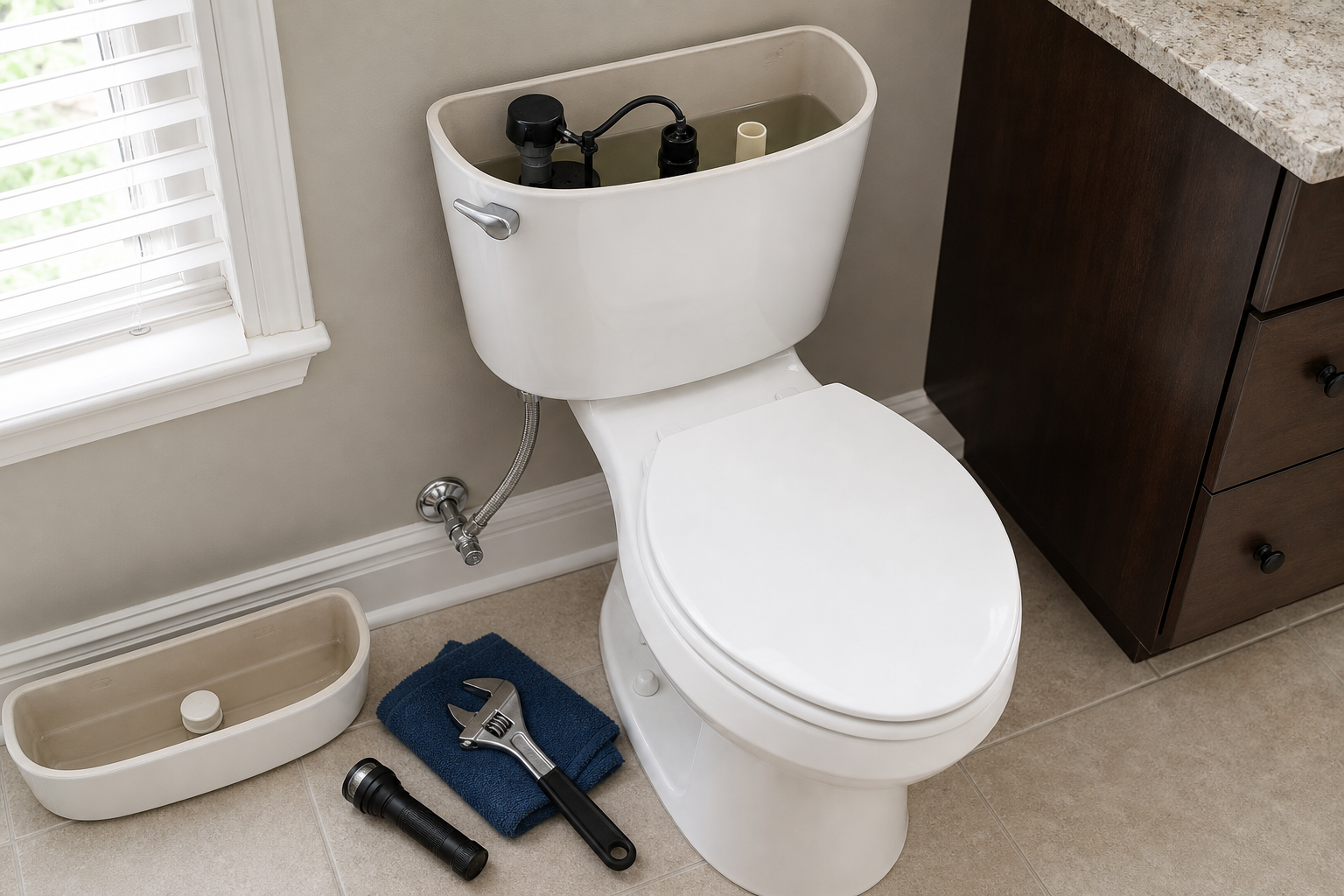
- Lift a removable gravity-tank lid with both hands and place it flat on a towel. Skip this step for concealed, wall-hung, electronic, or pressure-assisted systems.
- Photograph the toilet model label, fill-valve markings, overflow tube, refill tube, and marked waterline without moving them.
- Flush once. Record whether the whistle begins only when refill water starts and whether it stops when the tank reaches its intended line.
- Look for water continuing into the overflow, a tank level that later falls, external moisture, or a short refill that starts while the toilet is untouched.
KOHLER’s noisy-fill guidance separates standard gravity tanks from in-wall and pressure-assisted systems and uses model-specific paths. That is why a general sound guide should stop at observation rather than give one universal adjustment or cleaning procedure.
Before buying or servicing parts
Korky’s slow-fill guidance discusses supply opening, fill-valve condition, sediment, and model-specific servicing. Do not treat its steps as universal for unidentified valves. Identify the installed part first; replacement height, refill-tube placement, float adjustment, and service methods differ.
If the toilet model is unclear, use the manufacturer’s identification path. KOHLER’s model-identification guide, for example, begins by separating one-piece, two-piece, and intelligent toilets. A toilet from another maker needs that maker’s exact documentation.
When to stop and get help
Call a plumber if the shutoff is corroded, stuck, dripping, or difficult to reach; water enters the overflow continuously; the tank or supply leaks externally; the toilet rocks; the floor is soft; several fixtures whistle or change together; or the system is concealed, in-wall, pressure-assisted, electronic, or unidentified. Do not diagnose a pressure regulator from sound alone, perform a pressure test from a generic article, or repeatedly operate an old valve to see whether the pitch changes.
Sources for this guide
- Korky — How to Fix a Loud or Broken Fill Valve — supports associating a refill-time squeal or whistle with restricted internal fill-path flow while treating buildup, sticking components, and wear as possibilities; accessed July 14, 2026.
- Korky — No Water in Toilet Tank? Slow-Filling Toilet — supports checking active refill behavior and keeping valve service model-specific; accessed July 14, 2026.
- KOHLER Assist — Noisy Tank Fill Cycle (Standard Toilet Tank) — supports separating standard tank noise from in-wall and pressure-assisted systems; accessed July 14, 2026.
- KOHLER Assist — I Don’t Know My Toilet Model — supports beginning model identification by distinguishing one-piece, two-piece, and intelligent toilets before using replacement or service guidance; accessed July 14, 2026.
Decision aid: Whistling Toilet During Refill: Causes and Safe Checks
Start by identifying the relevant symptom, fixture, or planning question before choosing parts or arranging work.
Write down when the issue began, what changed, which fixtures are affected, and any model or service-history details. That record makes it easier to compare the article with the exact product documentation and to explain the problem if qualified help is needed.
- Confirm the toilet model, whether the symptom occurs during refill or flushing, and whether water is visible outside the bowl or tank.
- Match product-specific directions to the exact model manual and confirm local requirements where installation, gas, electricity, water quality, or structural work is involved.
- Stop if the toilet rocks, leaks at the base, the shutoff is stuck, or more than one fixture backs up.
Authoritative references for this topic
Use the current version of these sources to verify safety, efficiency, health, or product-specific details that apply to your situation.