Toilet
Why a Toilet Makes a Hissing Sound After Flushing
Separate normal refill sound from continuous hissing, recurring tank-to-bowl leakage, and shutoff or supply noise before buying toilet parts.
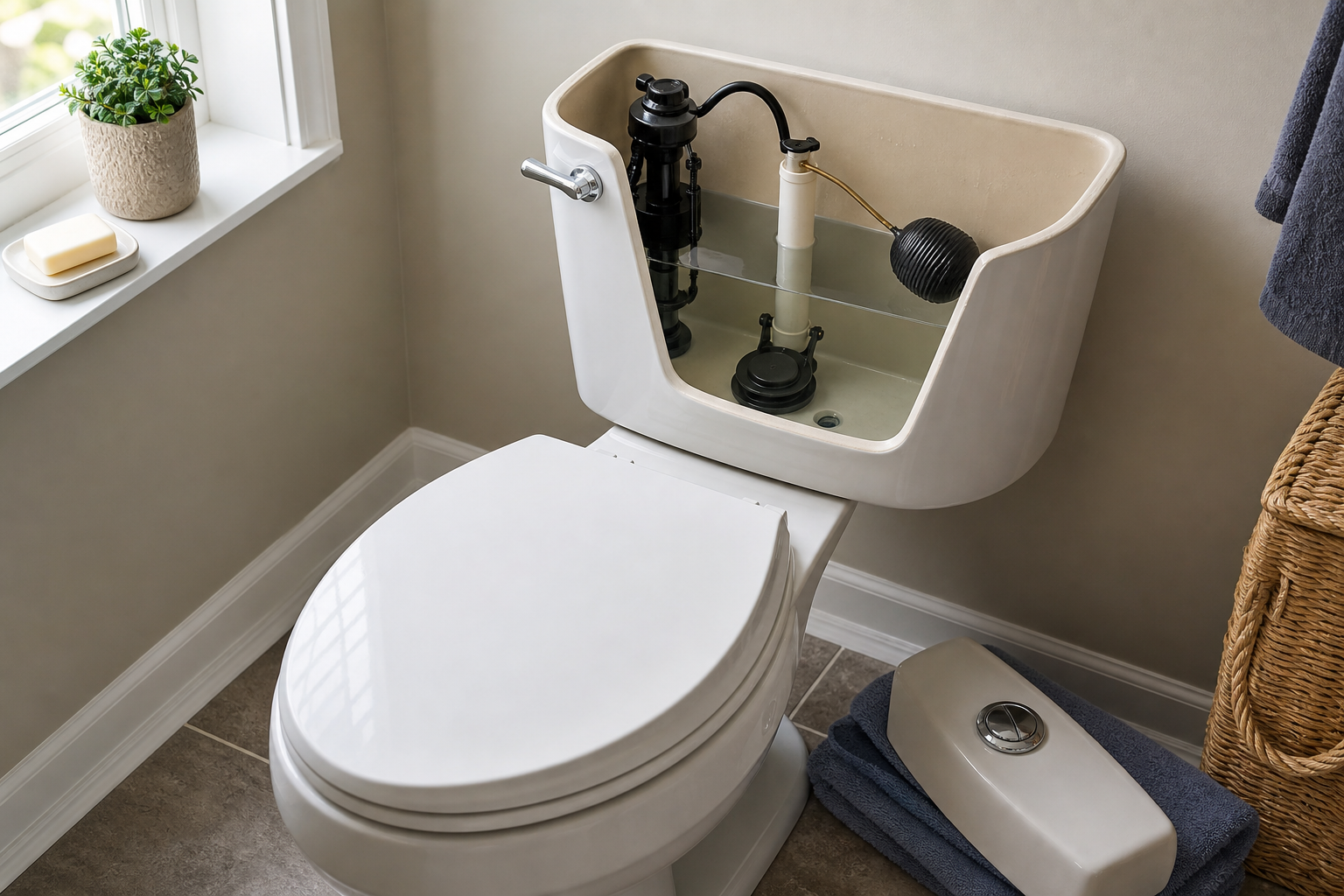
Quick answer
A soft flow sound confined to the visible refill period may simply accompany normal water movement. A hiss that continues after the tank should be full means water is still moving somewhere; overflow flow, incomplete fill-valve shutoff, and tank-to-bowl loss are possibilities rather than a one-part diagnosis. Only if the toilet is an identified conventional gravity model with a removable tank lid, lift the lid with both hands and place it flat on a towel before watching one flush. Note whether water reaches the overflow tube, whether the float rises freely, and whether the sound stops at the tank's marked waterline.
Korky’s toilet-anatomy guide explains the underlying sequence: after a flush, the fill valve refills the tank and bowl, the float rises, and the valve should shut off at the intended level. From that documented sequence, a soft sound confined to visible refill may accompany ordinary water movement; the source does not label every brief hiss normal.
This guide owns a soft hiss that begins immediately after flushing. A tonal whistle or squeal confined to active refill belongs in the whistling-during-refill guide. A high-pitched sound that first begins between uses belongs in the idle high-pitched-noise guide. Do not force the shutoff, bend the float, or buy a fill valve until the exact mechanism is identified.
Match the sound pattern before touching parts
| Sound pattern | What to observe | What it may suggest | Safe decision |
|---|---|---|---|
| Soft hiss stops when the tank reaches its waterline | Normal refill time and no water entering the overflow | Ordinary refill sound | Monitor unless the sound is new or unusually loud; if refill is slow, use the duration-focused guide. |
| Hiss continues while water enters the overflow tube | Float position and fill-valve shutoff | Water level set too high, float binding, or fill valve not shutting off | Identify the toilet and fill-valve model before using any adjustment instructions. |
| Hiss stops, then a separate high-pitched sound starts between uses | Whether the tank level fell and refill water restarted | A later tank-loss or idle refill event | Use the idle-noise guide or settled-tank-loss guide rather than treating it as one continuous post-flush hiss. |
| Hiss is at the wall valve or supply line | Corrosion, vibration, moisture, or sound change when fixtures run | The sound may be outside the toilet tank mechanism | Do not force or repeatedly operate an old or leaking shutoff; record the location for qualified diagnosis. |
Safe observation and leak check
- Lift a removable gravity-tank lid with both hands and place it flat on a towel. Do not open concealed or pressure-assisted systems.
- Flush once and watch the handle, chain, seal, float, refill tube, fill valve, overflow tube, and waterline without disassembling them.
- If the tank becomes full but the hiss continues, record whether water is entering the overflow tube or slipping quietly into the bowl.
- If a slow tank-to-bowl leak is suspected, first let the tank fill completely and settle at its intended waterline. Then add a few drops of food coloring to the clean tank, wait about 10 minutes without flushing, and inspect the bowl. Color appearing in the bowl before a flush indicates that tank water is leaking into it. Flush promptly after the check. EPA WaterSense describes this procedure in its household leak guidance.
- Photograph the tank mechanism and model markings before shopping for parts.
A positive dye test shows that tank water is reaching the bowl; it does not identify whether the correct repair is a flapper, canister seal, flush-valve part, or another model-specific component.
When to call a plumber
- The shutoff is stuck, corroded, dripping, or difficult to reach.
- Water is outside the tank, around tank bolts, at the supply connection, or on the floor.
- The toilet rocks, the floor feels soft, sewage odor is present, or other fixtures gurgle.
- The tank is cracked, pressure-assisted, concealed, wall-hung, electronic, or uses a mechanism you cannot identify.
- The hiss remains after a compatible model-specific seal or fill-valve issue has been correctly addressed.
EPA WaterSense notes that common household leaks include worn toilet flappers and can waste substantial water over time; the exact loss depends on the fault, so avoid universal gallon or dollar claims and use your actual meter and utility rate.
Sources for this guide
- Korky — How a Toilet Works: Anatomy of a Toilet — supports the normal tank-and-bowl refill sequence and float-controlled fill-valve shutoff; accessed July 14, 2026.
- U.S. EPA WaterSense — Checking for Leaks — supports adding food coloring, waiting without flushing, inspecting the bowl before a flush, and flushing promptly afterward; accessed July 14, 2026.
- Korky — How to Fix a Loud or Broken Fill Valve — supports routing a tonal active-refill whistle away from a generic soft-hiss diagnosis; accessed July 14, 2026.
- KOHLER Assist — Noisy Tank Fill Cycle (Standard Toilet Tank) — supports model-specific diagnosis and excluding in-wall or pressure-assisted systems from generic tank steps; accessed July 14, 2026.
Related guides
Decision aid: Why a Toilet Makes a Hissing Sound After Flushing
Start by identifying the relevant symptom, fixture, or planning question before choosing parts or arranging work.
Write down when the issue began, what changed, which fixtures are affected, and any model or service-history details. That record makes it easier to compare the article with the exact product documentation and to explain the problem if qualified help is needed.
- Confirm the toilet model, whether the symptom occurs during refill or flushing, and whether water is visible outside the bowl or tank.
- Match product-specific directions to the exact model manual and confirm local requirements where installation, gas, electricity, water quality, or structural work is involved.
- Stop if the toilet rocks, leaks at the base, the shutoff is stuck, or more than one fixture backs up.
Authoritative references for this topic
Use the current version of these sources to verify safety, efficiency, health, or product-specific details that apply to your situation.