Faucet & Sink
Kitchen Faucet Handle With No Visible Screws: What to Check First
A handle with no visible screw may conceal a model-specific fastener; identify the exact faucet and official diagram before touching the finish.
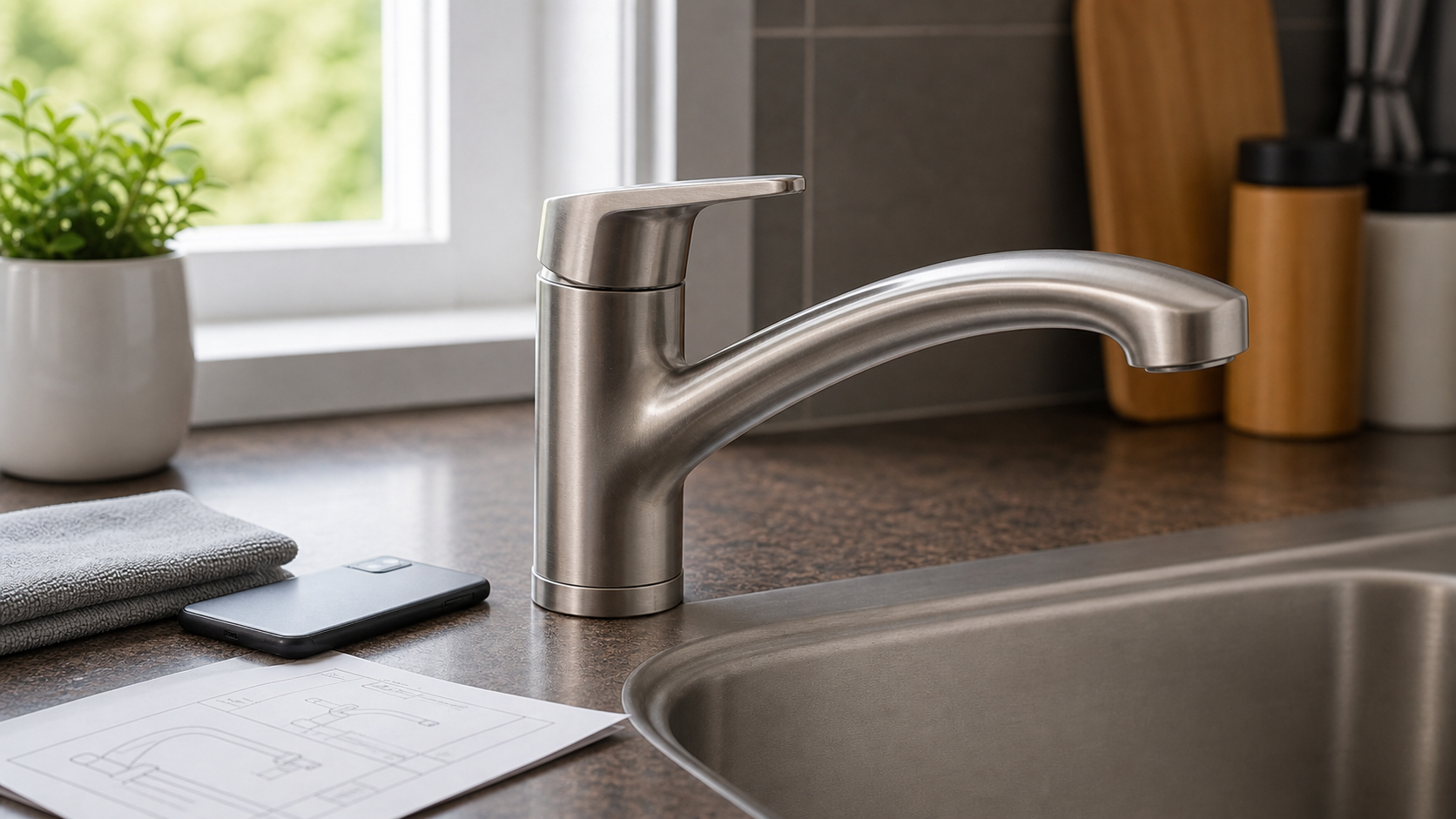
Quick answer
A kitchen faucet handle with no visible screw is not necessarily screwless. A model-specific plug, button, or side or underside access point may conceal a fastener. Threaded and quarter-turn or slide-on hub instructions can describe a later step after the handle is removed; they do not prove how an opening-free handle is retained. Do not pry the trim or try a guessed tool. Identify the exact faucet and compare its official parts diagram or service document before touching the handle.
This guide stops at identification. It does not cover cartridge removal, shutoff operation, valve work, faucet-body movement, mounting hardware, supply lines, or hidden plumbing.
What “no visible screw” can mean
| What you can see | What model documents may show | Safe next step |
|---|---|---|
| A plug or button in the handle or hub | Some documented models place fastener access behind a plug; other models do not use one | Find the exact exploded diagram before treating the plug as removable |
| A small side or underside opening | A model-specific set screw or access point | Match its location to the official document; do not test random hex keys |
| A smooth dome or hub with no opening | A hub-removal step that occurs only after a separately retained handle is removed | Leave the handle unidentified; do not twist or pull based on hub instructions alone |
| Corrosion, a deformed opening, moving trim, or active water | The identification step is no longer low risk | Photograph it and arrange manufacturer or plumber help without applying force |
Moen’s separate threaded-dome and slide-on-dome support pages show why appearance alone is unreliable. In both documented handle assemblies, an optional plug covers access to the set screw, and the set screw retains the handle; the threaded versus quarter-turn distinction applies to removing the hub afterward. Those pages are examples of the documented Threaded Dome and Slide On Dome handle assemblies, not evidence that a smooth opening-free handle uses either method.
Identify the faucet before touching trim
- Photograph the full faucet, handle from several angles, spout shape, finish, and any accessible logo or marking.
- Check the original box, instruction sheet, receipt, installer paperwork, or saved product registration.
- Do not assume that a number on the faucet is the exact model. Moen notes that some markings identify only a broader series.
- Use the manufacturer’s official parts locator or support channel to compare the complete faucet image and documented handle orientation.
- Do not substitute a similar-looking model when the access point, hub shape, or exploded view differs.
If identification would require moving the faucet, reaching around supply connections, opening electronic components, or disturbing mounting hardware, stop. Send the photographs and accessible records to manufacturer support or a plumber instead.
Use the official manual or parts diagram
Match more than the finish and lever shape. Compare the handle orientation, access-point location, hub or dome profile, and the order of parts in the exploded view. A model-specific document may name a fastener and tool, but that information applies only after the exact faucet model and documented handle assembly have been confirmed.
KOHLER’s guide for models K-12171, K-12172, K-12173, K-12175, and K-12176 diagrams a plug button above a screw, handle, and bonnet. That is evidence for those listed models—not proof that every smooth kitchen-faucet handle hides the same parts.
Protect the finish while identifying it
Use bright light, dry hands, and a clean soft cloth while inspecting the outside of the faucet. Do not use metal prying tools, pliers, abrasives, penetrants, acids, vinegar, heat, or unlisted solvents. KOHLER’s model guide directs owners to mild soap, warm water, and a soft cloth and warns against abrasive rubbing and cleaners containing abrasives, ammonia, bleach, acids, or finish-damaging chemicals.
Finish care is model- and manufacturer-specific. If a cleaner or tool is not allowed by the exact care document, do not use it merely to expose a suspected fastener.
When to stop and get qualified help
- The official document does not clearly match the installed faucet.
- No documented access point is visible, or a plug or hub does not release without force.
- A fastener opening is corroded, rounded, painted over, or beginning to deform.
- The handle, hub, faucet body, or base moves together.
- Water appears at the handle, spout base, countertop, or cabinet.
- A shutoff is stuck or leaking, or the document calls for faucet movement or work below the sink.
- The faucet is electronic or touchless, or identification leads to cartridge, valve, wiring, supply-line, or mounting work.
Send support the full-faucet photographs, exact markings, likely series or model evidence, finish, symptom, leak location, and the document you already checked.
Sources for this guide
- Moen: How can I find my model number? — distinguishes exact model information from broader series markings and points readers to official parts identification; accessed July 14, 2026.
- Moen: Kitchen Handle Side Mount — Threaded Dome — documents the Threaded Dome handle assembly, notes that an access plug is not used on every faucet, and identifies below-sink movement as a stop boundary for this guide; accessed July 14, 2026.
- Moen: Kitchen Handle Side Mount — Slide On Dome — documents the quarter-turn hub arrangement in the Slide On Dome handle assembly; accessed July 14, 2026.
- KOHLER Homeowners Guide 1004633-5-C — provides a model-specific plug-button and parts example plus manufacturer finish-care limits; accessed July 14, 2026.
Related guides
Decision aid: Kitchen Faucet Handle With No Visible Screws: What to Check First
Start by identifying the relevant symptom, fixture, or planning question before choosing parts or arranging work.
Write down when the issue began, what changed, which fixtures are affected, and any model or service-history details. That record makes it easier to compare the article with the exact product documentation and to explain the problem if qualified help is needed.
- Separate a faucet or supply symptom from a drain symptom, and note whether it affects hot water, cold water, or both.
- Match product-specific directions to the exact model manual and confirm local requirements where installation, gas, electricity, water quality, or structural work is involved.
- Stop if water reaches a cabinet, wall, floor, or electrical part, or if a shutoff or fixture starts to move when it should not.
Authoritative references for this topic
Use the current version of these sources to verify safety, efficiency, health, or product-specific details that apply to your situation.