Dishwasher
How to Load a Dishwasher Without Blocking Spray or Detergent
Good dishwasher loading keeps spray arms, detergent doors, filters, and rack movement clear while following the model manual.
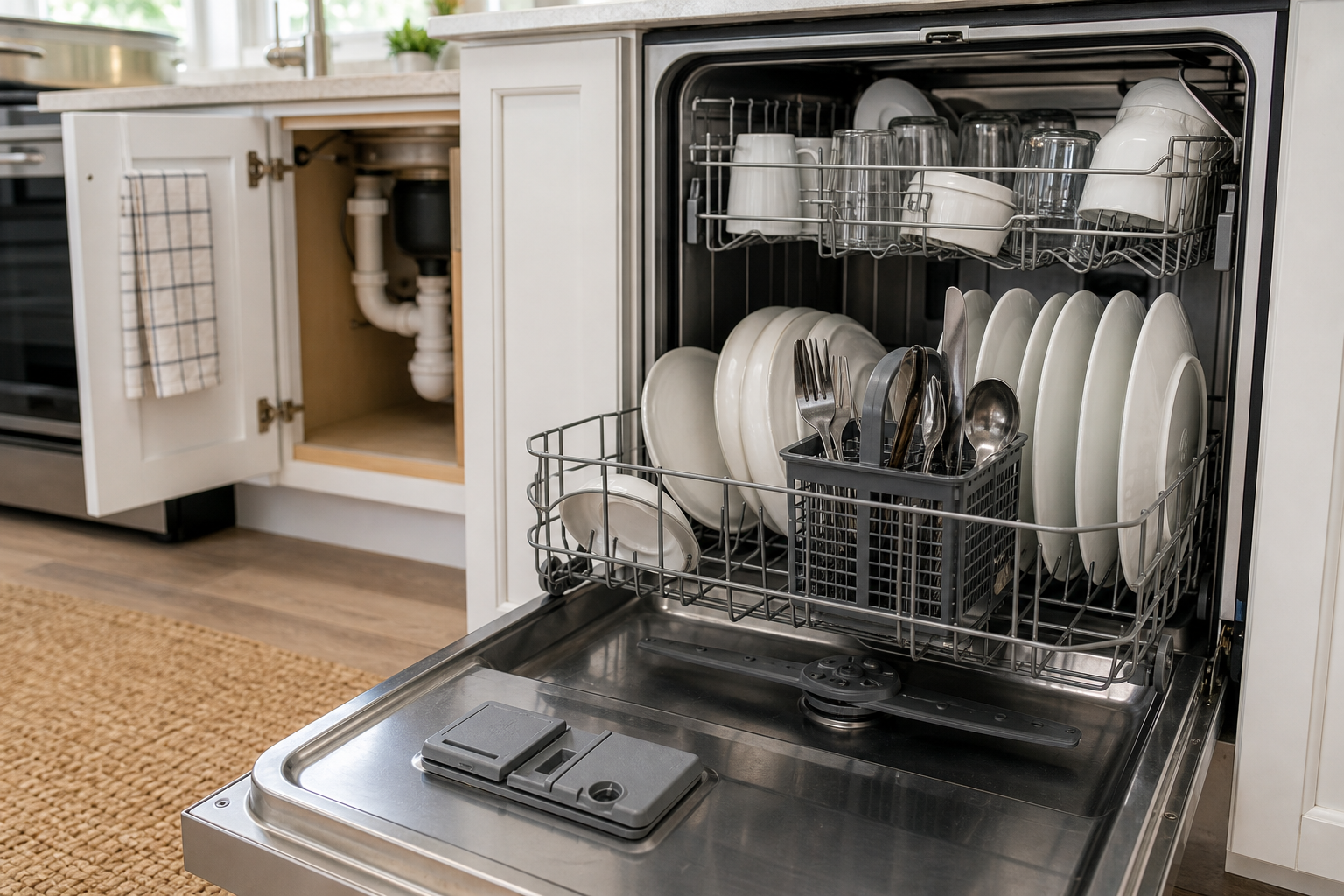
What to know about How to Load a Dishwasher Without Blocking Spray or Detergent
The best way to load a dishwasher is to keep spray paths, detergent dispenser doors, filters, and rack movement clear while facing dirty surfaces toward the spray. Exact placement still depends on the model, rack design, soil level, detergent, and manufacturer manual, so treat loading diagrams as model-specific guidance rather than universal rules.
Quick loading decision table
| Item or issue | Best placement/check | Why it matters |
|---|---|---|
| Plates and bowls | Face dirty surfaces inward/down toward spray | Blocked spray leaves soil or detergent residue. |
| Cups and glasses | Angle downward between tines, not over tine tips | Prevents pooling and improves rinse reach. |
| Large pans/cutting boards | Sides or back only if they do not block arms | Tall items can shadow an entire rack. |
| Silverware | Mix directions unless the manual says otherwise | Nesting spoons/forks keeps water out. |
| Detergent pod/tablet | Use dispenser unless manual allows another location | Loose pods can dissolve too early. |
Model-manual checklist
- Spin spray arms by hand before starting; nothing should hit them.
- Open and close the detergent dispenser door after loading to confirm clearance.
- Check whether the upper rack height should be raised or lowered for tall items.
- Keep the filter area and sump screen clear of labels, food chunks, glass, and utensils.
- Scrape large food pieces, but do not prewash so heavily that detergent has nothing to act on unless the manual or detergent label advises it.
- Place plastics only where the manual says they are safe, often top rack only.
Symptom-to-loading clue table
| Symptom | Possible loading cause | What to change next cycle |
|---|---|---|
| Pod still in cup/dispenser | Door blocked or cycle too short/cold | Move tall items away from dispenser. |
| Dirty bowls on top rack | Bowls nested or facing wrong direction | Space bowls and face soil toward spray. |
| Glasses hold water | Flat placement or wrong angle | Tilt glasses/cups so water drains. |
| Bottom rack clean, top rack dirty | Upper spray arm blocked or rack overfilled | Check arm rotation and spacing. |
| Food redeposited | Filter/sump blocked or too much debris | Clean filter per manual and scrape large solids. |
What not to load or force
- Do not block the detergent dispenser with cutting boards, pans, or tall plates.
- Do not force knives, lids, or utensils where they can stop spray arms.
- Do not put wood, cast iron, delicate crystal, hand-painted items, or non-dishwasher-safe plastics in unless the item label allows it.
- Do not ignore repeated poor cleaning; it may be a filter, pump, heater, water, or detergent issue rather than loading alone.
When to call an appliance technician or plumber
Call an appliance technician if loading changes do not improve cleaning, spray arms do not move, the dispenser fails, dishes stay cold/wet unexpectedly, or error codes appear. Call a plumber if the dishwasher backs up into the sink, the air gap overflows, the drain hose is misrouted, or under-sink connections leak.
What to document before service
- Brand, model number, serial tag location, and any blinking lights or error code.
- When the issue happens: startup, fill, wash, drain, dry cycle, or after sitting unused.
- Photos of the filter area, spray arms, detergent cup, air gap/high loop, under-sink drain connection, and any floor or cabinet water.
- Recent changes: new detergent, rinse aid, disposer installation, plumbing work, power outage, or water-quality changes.
Decision aid: How to Load a Dishwasher Without Blocking Spray or Detergent
Start by identifying the relevant symptom, fixture, or planning question before choosing parts or arranging work.
Write down when the issue began, what changed, which fixtures are affected, and any model or service-history details. That record makes it easier to compare the article with the exact product documentation and to explain the problem if qualified help is needed.
- Find the exact model manual and separate appliance behavior from the drain hose, air gap, disposer, or sink connection.
- Match product-specific directions to the exact model manual and confirm local requirements where installation, gas, electricity, water quality, or structural work is involved.
- Stop for leaking near electrical parts, repeated error codes, a recently disturbed hose, or water that returns after visible cleaning.
Authoritative references for this topic
Use the current version of these sources to verify safety, efficiency, health, or product-specific details that apply to your situation.